
Running a Shopify store involves much more than listing products and processing orders. From managing inventory and updating product catalogs to coordinating shipments and handling daily administrative tasks, keeping an ecommerce business running smoothly requires consistent effort.
As your store grows, these responsibilities can consume hours that could be better spent on marketing, product development, and business expansion.
That's where a Shopify virtual assistant (VA) can help.
A Shopify virtual assistant is a remote professional who handles recurring store operations, administrative work, and ecommerce-related tasks. Depending on their expertise, they can manage product listings, inventory updates, order administration, website content, reporting, and customer communication.
You can hire a Shopify VA independently through freelance platforms or work with an outsourcing provider like Helplama, which offers trained ecommerce professionals for Shopify support operations.
But how do you find the right assistant, what should you delegate, and how much should you expect to pay?
This guide covers everything you need to know about hiring a Shopify virtual assistant, including responsibilities, costs, hiring platforms, screening methods, and the differences between freelancers and outsourced services.
- What Is a Shopify Virtual Assistant?
- What Tasks Can a Shopify VA Handle?
- When Should You Hire a Shopify VA?
- How to Hire: Step-by-Step
- How Much Does It Cost?
- What Affects Shopify VA Pricing?
- Freelancer vs. Outsourced VA
- Why Choose Helplama?
- How to Onboard and Manage Your VA
- Job Description Template
- Frequently Asked Questions
What Is a Shopify Virtual Assistant?
A Shopify virtual assistant is a remote professional who helps ecommerce businesses manage their Shopify stores and related administrative activities.
Unlike a general virtual assistant, someone with Shopify experience understands ecommerce workflows, product catalogs, inventory records, order management, and the tools used to operate an online store.
Depending on their experience, a Shopify VA can help with:
- Product uploads and catalog management
- Inventory tracking and SKU updates
- Order processing and fulfillment coordination
- Shopify website content updates
- Marketing and promotional administration
- Ecommerce reporting and data entry
- Customer communication and order-related support
Some Shopify virtual assistants specialize in one function, while others handle multiple operational responsibilities.
For example, a small Shopify store might hire a part-time VA to upload products and update inventory records. A larger ecommerce business might need dedicated professionals for order administration, customer communication, and daily store operations.
Shopify virtual assistants can work part-time, full-time, hourly, or on a project basis. They may be independent freelancers or professionals assigned through outsourcing companies.
The best hiring arrangement depends on your store's workload, budget, and required expertise.
What Tasks Can a Shopify Virtual Assistant Handle?
A Shopify virtual assistant can take over many repetitive activities that keep an ecommerce store functioning. However, the exact responsibilities depend on their technical knowledge and the processes you want to delegate.
1Shopify Product Uploads and Product Management
Adding new products and maintaining existing listings is one of the most common responsibilities assigned to Shopify virtual assistants.
A Shopify VA can help:
- Upload new products to your Shopify store.
- Write and update product titles and descriptions.
- Add product images and specifications.
- Create product variants, including sizes, colors, and materials.
- Assign products to relevant collections.
- Update product prices and promotional information.
- Organize product tags and categories.
- Identify incomplete or inaccurate listings.
If your store contains hundreds or thousands of products, look for someone experienced in Shopify CSV imports, bulk product uploads, and spreadsheet management.
2Inventory and Product Catalog Administration
Accurate inventory information helps prevent stock discrepancies, overselling, and operational errors.
A Shopify virtual assistant can support inventory administration by:
- Updating inventory quantities.
- Monitoring stock records.
- Maintaining SKU information.
- Identifying missing or inconsistent product data.
- Preparing low-stock reports.
- Reviewing product availability.
- Coordinating inventory information across sales channels.
- Maintaining product collections and categories.
For businesses selling through Shopify alongside Amazon, eBay, or other marketplaces, experience with multichannel inventory workflows can be particularly valuable.
3Order Processing and Fulfillment Coordination
As order volumes increase, routine administrative work can become difficult to manage consistently.
Shopify virtual assistants can assist with:
- Reviewing incoming orders.
- Verifying order information.
- Updating order records.
- Coordinating fulfillment activities.
- Monitoring shipment and tracking information.
- Flagging delayed or incomplete orders.
- Preparing order reports.
- Escalating exceptions that require management approval.
Order-related support is also an area where outsourcing providers such as Helplama can help Shopify merchants manage recurring ecommerce support activities.
For sensitive actions such as refunds, order cancellations, or payment modifications, businesses should establish clear authorization procedures.
4Shopify Store Management and Website Updates
Maintaining an organized Shopify storefront requires regular updates.
A virtual assistant can help with routine website administration, including:
- Updating homepage banners.
- Editing product and collection pages.
- Maintaining navigation menus.
- Publishing blog posts.
- Updating promotional content.
- Checking product images and broken links.
- Refreshing seasonal collections.
- Coordinating website content changes.
However, advanced Shopify theme development, custom Liquid coding, and complex integrations generally require a qualified Shopify developer rather than a general VA.
5Marketing and Content Administration
Shopify virtual assistants with relevant marketing experience can help execute recurring promotional activities.
These tasks may include:
- Scheduling social media content.
- Updating promotional banners.
- Uploading email marketing assets.
- Preparing product descriptions.
- Maintaining promotional calendars.
- Researching competitor products and prices.
- Organizing influencer campaign information.
- Compiling basic marketing performance reports.
These responsibilities are generally administrative. Running paid advertising campaigns, developing an SEO strategy, or managing advanced marketing automation requires additional expertise.
6Reporting, Research, and Data Entry
Reliable reporting helps Shopify merchants identify operational issues and monitor business performance.
Virtual assistants can support reporting by:
- Preparing weekly sales reports.
- Maintaining inventory spreadsheets.
- Organizing supplier information.
- Tracking recurring operational tasks.
- Collecting competitor pricing information.
- Updating ecommerce dashboards.
- Reviewing data for inconsistencies.
- Preparing performance summaries.
For data-heavy stores, strong spreadsheet skills are particularly important.
When Should You Hire a Shopify Virtual Assistant?
Hiring a Shopify virtual assistant becomes worthwhile when recurring administrative activities begin affecting your ability to focus on business growth.
Consider hiring a VA if:
- You spend several hours every week updating products.
- Your product catalog requires frequent maintenance.
- Inventory administration is becoming difficult to manage.
- Order-related tasks are taking too much time.
- Routine store updates are frequently delayed.
- You're expanding into additional products or marketplaces.
- Your existing team needs help with repetitive activities.
- You need consistent operational assistance without hiring another in-house employee.
For example, suppose your store requires 15 hours every week for product uploads, inventory updates, and order administration.
Instead of spending that time on repetitive work, you could delegate those responsibilities to a part-time Shopify VA and focus on marketing, merchandising, and improving conversions.
The key is to determine how much work needs to be delegated before deciding whether you need part-time, full-time, or specialized support.
How to Hire a Shopify Virtual Assistant: Step-by-Step
Hiring the right Shopify VA involves more than finding someone familiar with the Shopify dashboard.
You need to evaluate their experience, reliability, communication, accuracy, and ability to follow your store's operating procedures. Here's a practical seven-step hiring process.
Define the Tasks You Want to Delegate
Start by identifying which responsibilities consume the most time. Create a list of tasks and divide them according to frequency.
| Task Category | Examples |
|---|---|
| Daily tasks | Product updates, order administration, inventory checks, website content changes |
| Weekly tasks | Catalog audits, performance reporting, competitor research |
| Occasional tasks | Bulk product uploads, collection restructuring, seasonal promotions |
For each responsibility, document the expected workload, required tools, and completion criteria.
For example, instead of simply requesting someone to manage your product catalog, specify that you need an assistant to upload 100 products weekly, maintain product variants, and verify listing accuracy.
Clearly defined responsibilities make it easier to evaluate candidates and estimate hiring costs.
Choose Between a Freelance VA and an Outsourcing Company
There are two primary ways to hire Shopify virtual assistants.
Option 1: Hire a freelancer directly
You can recruit an independent Shopify virtual assistant through freelance marketplaces or remote hiring platforms. With this approach, you typically handle:
- Candidate sourcing and screening.
- Interviews and assessments.
- Training and onboarding.
- Daily task assignment.
- Performance monitoring.
- Replacement hiring when necessary.
Direct hiring can be cost-effective when you have clearly defined responsibilities and sufficient time to manage the assistant.
Option 2: Hire through a Shopify outsourcing provider
An outsourcing company can help you find professionals with relevant ecommerce experience while handling some of the administrative responsibilities associated with recruitment and staffing.
Depending on the provider, services may include sourcing, training, supervision, payroll administration, performance monitoring, and replacement arrangements.
For Shopify businesses focused on customer communication, order coordination, and related ecommerce support, Helplama offers dedicated Shopify support professionals and managed outsourcing options.
Rather than building an internal support team, merchants can discuss their operational requirements with Helplama and establish a suitable staffing arrangement.
For general store administration, such as bulk product uploads or complex inventory updates, confirm that the provider can supply professionals with those specific skills.
Find Shopify Virtual Assistant Candidates
Once you've selected a hiring model, the next step is identifying suitable candidates or providers. Here are some options worth considering.
| Platform or Provider | Hiring Model | Best Suited For |
|---|---|---|
| Helplama | Ecommerce outsourcing provider | Shopify customer support, order-related assistance, and managed ecommerce support |
| Upwork | Freelance marketplace | Hiring independent Shopify VAs for hourly or project-based work |
| Fiverr | Freelance services marketplace | Individual Shopify tasks and defined projects |
| OnlineJobs.ph | Remote hiring platform | Finding Philippines-based Shopify virtual assistants |
Hiring Shopify Support Professionals Through Helplama Managed Ecommerce Support
Helplama provides outsourcing services for ecommerce businesses, including Shopify stores that need trained agents for recurring support activities.
Its Shopify-related capabilities include:
- Order-status and tracking inquiries.
- Shipping and fulfillment-related communication.
- Returns and exchanges support.
- Email and live chat communication.
- Social media customer inquiries.
- Store-specific agent training.
- Quality monitoring and performance reporting.
This approach can be useful for businesses that want dedicated ecommerce support without independently recruiting and managing every support agent.
You can explore Helplama's Shopify customer service outsourcing services or contact the team to discuss staffing requirements.
Screen Candidates for Shopify-Specific Skills
Not every virtual assistant with ecommerce experience has the skills required to manage a Shopify store. Evaluate candidates according to the work you plan to delegate.
| Skill | What to Evaluate |
|---|---|
| Shopify administration | Ability to navigate Shopify and complete assigned store tasks |
| Product management | Experience creating listings, variants, collections, and descriptions |
| Inventory administration | Understanding of SKUs, stock records, and inventory updates |
| Ecommerce operations | Knowledge of order processing and fulfillment workflows |
| Spreadsheet skills | Experience with Excel, Google Sheets, and CSV files |
| Content management | Ability to update website and product information accurately |
| Communication | Ability to report progress and clarify requirements |
| Attention to detail | Accuracy when handling product information and operational records |
Ask candidates about their actual responsibilities in previous Shopify roles.
Someone who has handled basic product uploads may not have the experience required to manage complex inventory workflows or multichannel operations.
Conduct a Practical Shopify Skills Assessment
A practical assessment can help determine whether a candidate has the required experience. For example, provide sample product data and ask them to:
- Identify incomplete product information.
- Prepare accurate product titles and descriptions.
- Organize product variants.
- Assign products to appropriate collections.
- Identify errors in SKU or inventory records.
You can also ask candidates to explain how they would prepare a bulk CSV upload or resolve an inventory discrepancy.
Avoid providing unrestricted access to your live Shopify store during recruitment. Use sample data or a development environment instead.
Assess candidates based on accuracy, turnaround time, communication, and attention to instructions.
Interview Shortlisted Candidates
Once candidates complete their assessments, conduct interviews to understand their experience and working style. Some useful questions include:
Shopify Experience
- How many Shopify stores have you worked with?
- Which Shopify tasks have you handled independently?
- Have you managed large product catalogs?
- Are you familiar with Shopify CSV imports and exports?
Operational Experience
- How would you organize a store with thousands of products?
- How do you identify inaccurate inventory records?
- What steps would you follow before updating product information in bulk?
Communication and Reliability
- What working hours can you commit to?
- How do you track recurring assignments?
- How do you report errors or delays?
- Can you share examples of relevant previous work?
Evaluating an Outsourcing Company?
- How are agents selected?
- What does onboarding include?
- Who supervises day-to-day work?
- What are the replacement and performance-management policies?
Start With a Paid Trial
Before committing to a long-term arrangement, consider a short paid trial. For example, assign a limited set of responsibilities, such as:
- Updating a product collection.
- Preparing an inventory report.
- Organizing product information.
- Reviewing order records.
- Completing recurring administrative assignments.
Set measurable expectations for accuracy, turnaround time, and communication. A successful trial should demonstrate that the assistant can consistently follow your processes.
When hiring through an outsourcing provider, discuss whether an evaluation period, pilot arrangement, or performance review process is available.
Prefer not to recruit and manage support agents yourself? Talk to Helplama about dedicated Shopify support professionals for your store.
Talk to Helplama →How Much Does It Cost to Hire a Shopify Virtual Assistant?
The cost of hiring a Shopify virtual assistant depends on location, experience, working hours, specialization, and whether you hire directly or through an outsourcing company.
One important distinction is that freelance hourly rates and managed outsourcing prices are not directly equivalent.
Shopify Virtual Assistant Freelance Rates
According to eVirtualAssistants' Shopify VA marketplace data, the following benchmarks were reported for 2026:
- The median hourly rate offered across 53 Shopify VA job posts was approximately $5/hour.
- The middle 50% of employer offers ranged from $3–$6/hour.
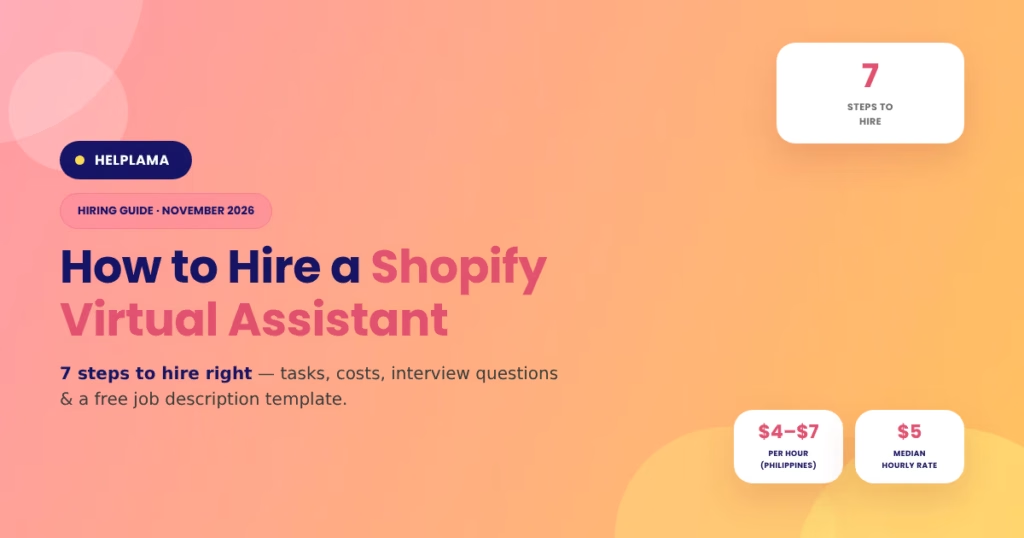
- Philippines-based Shopify VA profiles had a median asking rate of $5/hour, with the middle 50% ranging from $4–$7/hour.
Based on a $4–$7 hourly range, estimated monthly labor costs would be:
| Working Schedule | Approx. Monthly Hours | Est. Monthly Cost |
|---|---|---|
| 10 hours/week | 43 | $173–$303 |
| 20 hours/week | 87 | $346–$606 |
| 40 hours/week | 173 | $693–$1,211 |
For example, hiring a Shopify virtual assistant at $5/hour for approximately 20 hours per week would cost around $433 per month in direct labor.
These estimates exclude potential recruitment fees, platform charges, training, paid leave, equipment, and other applicable costs.
Shopify Virtual Assistant Outsourcing Agency Costs
Hiring through an outsourcing company generally costs more than paying a freelancer directly. However, agency fees may include additional services such as:
- Recruitment and candidate screening
- Onboarding and training
- Payroll administration
- Performance supervision
- Account management
- Replacement arrangements
A 2026 review of Philippines-based VA agency pricing reported that full-time general virtual assistants commonly cost approximately $1,500–$2,000 per month through outsourcing agencies.
Senior or specialized roles may cost approximately $2,000–$3,500 per month. Actual Shopify VA pricing depends on the responsibilities, experience required, and service arrangement.
How Much Does Helplama Cost?
For Shopify businesses interested in outsourcing customer communication and order-related support, Helplama offers ecommerce support services with published plans starting at $399 per month.
This starting price refers to Helplama's customer support offering rather than a guaranteed rate for a full-time, general-purpose Shopify virtual assistant.
The total cost will depend on the support channels, working hours, service requirements, and staffing arrangement. Businesses requiring dedicated support professionals or a customized arrangement should contact Helplama for pricing based on their needs.
Shopify Virtual Assistant Cost Comparison
| Hiring Option | Indicative Cost | Best Suited For |
|---|---|---|
| Freelance Shopify VA | $4–$7/hour | Stores that can manage independent freelancers |
| Full-time direct Shopify VA | $693–$1,211/month | Businesses with consistent administrative work |
| General VA outsourcing agency | $1,500–$2,000/month | Companies wanting outsourced recruitment and administration |
| Helplama Shopify customer support | Starting at $399/month | Shopify businesses needing outsourced ecommerce customer support |
The figures represent different hiring models, service scopes, and staffing arrangements. Compare the responsibilities and hours included in each option before making a decision.
What Factors Affect Shopify VA Pricing?
Several factors influence the final price.
Location: Virtual assistant rates vary by country and local labor market.
Experience: Professionals with extensive Shopify experience generally command higher rates than entry-level assistants.
Working hours: Full-time arrangements cost more overall but may offer a lower effective hourly rate than some short-term or specialized projects.
Specialization: Advanced inventory management, Shopify development, analytics, and marketing automation can require additional expertise.
Management model: Managed outsourcing may cost more than direct hiring because it can include recruitment, administration, supervision, and operational support.
Freelancer vs. Outsourced Shopify Virtual Assistant: Which Is Better?
Both hiring models have advantages. The best choice depends on how much operational responsibility you want to retain.
| Factor | Freelance Shopify VA | Outsourced Shopify VA or Support Provider |
|---|---|---|
| Recruitment | You find and interview candidates | Provider typically handles sourcing |
| Screening | Your responsibility | May be included |
| Training | You provide training | Provider may assist with onboarding |
| Daily management | Generally handled by you | Depends on the service arrangement |
| Replacement | You find a new freelancer | Replacement options may be available |
| Payroll administration | Handled by you or the freelance platform | Typically managed by the provider |
| Cost | Usually lower direct labor cost | Often includes additional services |
| Best suited for | Businesses comfortable managing freelancers | Businesses wanting structured or managed outsourcing |
- Your workload is relatively small.
- Tasks are clearly defined.
- You have time to train and supervise the assistant.
- Minimizing direct labor costs is a priority.
- You can manage recruitment and replacements independently.
- You don't want to manage recruitment yourself.
- You need consistent operational coverage.
- You want structured onboarding and supervision.
- You need dedicated ecommerce support professionals.
- You want to reduce the administrative burden of managing individual contractors.
For businesses that need Shopify-related customer support and order communication, working with an established ecommerce outsourcing provider such as Helplama can be a practical alternative to building an internal team.
Why Choose Helplama for Shopify Virtual Assistant Services?
Hiring Shopify virtual assistants independently can involve sourcing candidates, verifying their skills, conducting interviews, preparing training materials, and managing ongoing performance.
For ecommerce businesses that want to delegate customer-facing and order-related responsibilities, Helplama provides outsourced Shopify support services. Its approach combines trained ecommerce agents, store-specific workflows, and operational oversight.
1Shopify-Trained Ecommerce Support Professionals
Helplama provides ecommerce support agents who can be trained on Shopify-related workflows, product information, store policies, and customer communication requirements.
Instead of independently building training processes for every support hire, businesses can work with Helplama to establish support procedures aligned with their store.
2Support for Daily Shopify Order Operations
Order-related support is one of the recurring responsibilities for many Shopify businesses. Helplama can assist with:
- Responding to order-status inquiries.
- Providing shipping and tracking updates.
- Helping customers with returns and exchanges.
- Coordinating approved order-related requests.
- Escalating exceptions that require merchant approval.
3Dedicated Ecommerce Support Agents
Helplama offers dedicated support staffing arrangements for ecommerce businesses. Dedicated agents can develop familiarity with your products, policies, support procedures, and customer expectations.
This may be particularly useful for Shopify stores with recurring order inquiries or complex customer communication requirements.
4Store-Specific Training and Quality Monitoring
Helplama's outsourced support model includes training around business processes and quality monitoring. Store owners can establish procedures for common situations, escalation requirements, and approved actions.
Performance can then be evaluated using support accuracy, response times, resolution quality, and customer satisfaction.
5Flexible Customer Support Coverage
Customer inquiries don't always arrive during regular business hours. Helplama offers business-hours, after-hours, and 24/7 coverage options, depending on the selected service, across:
- Email.
- Live chat.
- Phone.
- Social media.
6Reduce the Administrative Burden of Support Staffing
Recruiting and managing support agents internally involves ongoing administrative work. An outsourcing arrangement can help reduce that burden by providing a more structured staffing and support model.
This can free up internal resources for product development, marketing, and business expansion.
Need Shopify support professionals for your store? Explore Helplama's Shopify outsourcing services or discuss your requirements with the team.
Contact Helplama →How to Onboard and Manage Your Shopify Virtual Assistant
After hiring a Shopify virtual assistant, the next step is establishing clear workflows and expectations. Even experienced assistants need instructions specific to your store.
1Create Standard Operating Procedures
Document recurring activities before delegating them. For example, a product-upload SOP should include:
- Required product fields.
- Product naming conventions.
- Description formatting.
- Image requirements.
- SKU and variant rules.
- Collection assignments.
- Review and approval procedures.
Screenshots, sample spreadsheets, and short training videos can make instructions easier to follow.
2Provide Secure Shopify Access
Avoid sharing your primary Shopify account credentials.
Shopify provides user roles and permissions that allow store owners to control access to different administrative functions. Eligible Shopify Partners can also request collaborator access. Use the permissions required for the assistant's actual responsibilities.
Review Shopify's documentation on collaborator accounts and Shopify admin access.
Enable two-step authentication and periodically review access permissions.
3Establish a Task Management Process
Use a shared task-management system such as Asana, Trello, or Monday.com. Each assignment should specify:
- What needs to be completed.
- When it is due.
- Required tools or resources.
- Expected output.
- Approval requirements.
- Who will review the work.
This reduces misunderstandings and helps maintain accountability.
4Define Performance Metrics
Evaluate your VA based on measurable results rather than simply tracking working hours. Useful metrics include:
| Performance Metric | What It Measures |
|---|---|
| Product upload accuracy | Percentage of listings completed without errors |
| Task completion rate | Percentage of assigned tasks completed on time |
| Inventory accuracy | Consistency between inventory records and approved source data |
| Rework rate | Number of tasks requiring corrections |
| Reporting accuracy | Reliability of submitted reports |
| Turnaround time | Time required to complete recurring assignments |
| Communication reliability | Timely updates and escalation of issues |
Set realistic expectations based on the complexity of each task.
5Conduct Regular Performance Reviews
Schedule frequent check-ins during the first few weeks. Review completed assignments, clarify instructions, and identify recurring mistakes.
As the assistant becomes more familiar with your store, you can gradually delegate additional responsibilities.
Shopify Virtual Assistant Job Description Template
If you're hiring a Shopify virtual assistant directly, use the following template to communicate your requirements.
Job Title: Shopify Virtual Assistant
Copy & CustomizeAbout the role
We are looking for an organized and detail-oriented Shopify Virtual Assistant to support the daily administrative and operational activities of our ecommerce store.
The ideal candidate should have hands-on experience with Shopify administration, product management, inventory records, and ecommerce workflows.
Key responsibilities
- Upload and maintain Shopify products.
- Update product descriptions, images, and variants.
- Organize product collections and catalog information.
- Maintain inventory and SKU records.
- Assist with order administration.
- Update store content and promotional information.
- Prepare operational reports and spreadsheets.
- Conduct product and competitor research.
- Follow established SOPs and meet assigned deadlines.
Required skills
- Experience using Shopify.
- Knowledge of ecommerce operations.
- Familiarity with product uploads and catalog management.
- Strong Excel or Google Sheets skills.
- Attention to detail.
- Written communication skills.
- Ability to follow instructions and meet deadlines.
Preferred qualifications
- Experience with Shopify CSV imports and exports.
- Experience managing large product catalogs.
- Familiarity with Shopify apps and integrations.
- Experience working with multichannel ecommerce businesses.
How to apply
Please provide your relevant Shopify experience, examples of previous work, availability, and expected hourly or monthly rate.
Frequently Asked Questions About Hiring a Shopify Virtual Assistant
What does a Shopify virtual assistant do?
A Shopify virtual assistant helps manage recurring ecommerce tasks such as product uploads, catalog updates, inventory administration, order processing, website updates, reporting, and marketing administration. Depending on their experience, they may also assist with customer communication.
How much does it cost to hire a Shopify virtual assistant?
A Philippines-based Shopify VA may cost approximately $4–$7 per hour when hired directly, based on marketplace benchmarks. Full-time general VA services through outsourcing agencies commonly cost around $1,500–$2,000 per month, depending on experience and the services included.
Where can I hire a Shopify virtual assistant?
You can hire Shopify virtual assistants through Upwork, Fiverr, OnlineJobs.ph, and specialist outsourcing companies. For Shopify order-related support and customer communication, Helplama offers trained ecommerce support professionals.
Can I hire a Shopify virtual assistant through Helplama?
Helplama advertises dedicated Shopify virtual assistants and ecommerce support agents for responsibilities such as order-related communication, shipping updates, returns coordination, and customer inquiries.
Businesses can contact Helplama to discuss their requirements, staffing preferences, and available outsourcing arrangements. Specialized administration or technical responsibilities should be confirmed before engagement.
Is it better to hire a freelance Shopify VA or use an outsourcing company?
Freelancers are generally less expensive in terms of direct labor costs, but businesses must handle recruitment, onboarding, supervision, and replacements.
Outsourcing companies may charge more because their services can include recruitment, training, administrative management, and operational oversight. The better option depends on your budget, workload, and management preferences.
What skills should a Shopify virtual assistant have?
A Shopify VA should understand Shopify administration, product management, inventory workflows, spreadsheets, ecommerce operations, and task organization. Additional skills may be necessary for specialized marketing, technical, or multichannel responsibilities.
Can a Shopify virtual assistant work part-time?
Yes. Shopify virtual assistants can work part-time, full-time, or on a project basis. Part-time arrangements are useful for stores that need help with recurring tasks but don't require full-time operational support.
How do I give a Shopify VA access to my store securely?
Create a separate user account or use an eligible collaborator account. Assign only the permissions needed for the assistant's responsibilities, enable two-step authentication, and avoid sharing owner credentials.
How long does it take to onboard a Shopify virtual assistant?
Onboarding time depends on the complexity of your store and the responsibilities being delegated. Routine product updates may require less preparation than complex inventory workflows or multichannel administration.
Prepare SOPs, sample tasks, and training materials before the assistant starts.
Hire Shopify Virtual Assistants With Helplama
Managing a growing Shopify store requires consistent attention to orders, product information, customer communication, and everyday ecommerce operations. For Shopify merchants that need outsourced ecommerce customer support, Helplama provides trained agents, dedicated staffing options, store-specific workflows, and quality monitoring, so your team can focus on improving your products, growing sales, and scaling your business.
Get Started With Helplama →