
Inbound customer service outsourcing lets businesses hand incoming customer questions, support requests, orders, complaints, and account issues to a specialized external team.
Instead of hiring, training, scheduling, and managing every support agent internally, businesses can work with an inbound customer service outsourcing company that handles customer interactions according to their processes, brand guidelines, and service-level requirements.
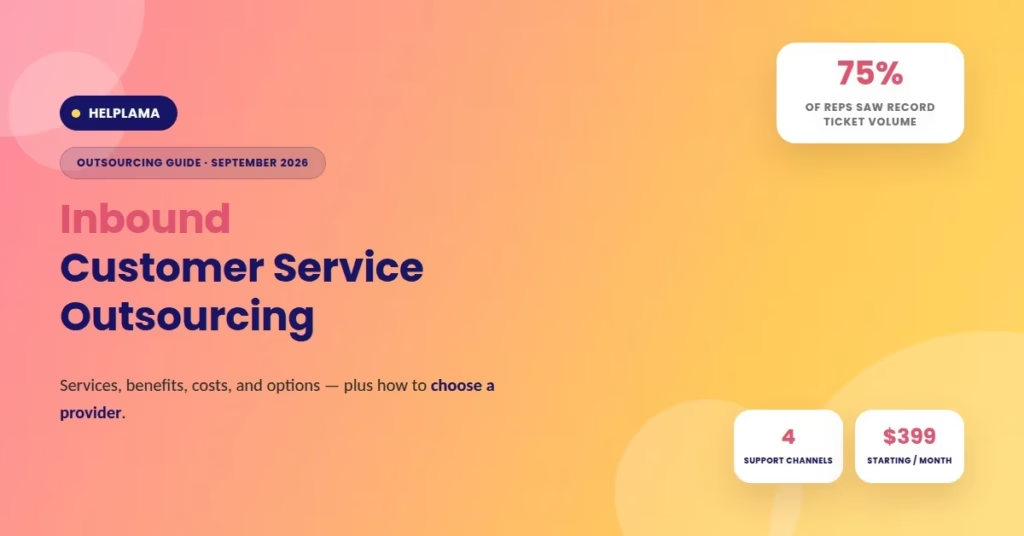
The need for scalable support is growing. 75% of customer service representatives reported seeing the highest-ever volume of customer service tickets in 2024, according to HubSpot's State of Customer Service research. At the same time, 78% of customers expect more personalization options than ever before.
That combination creates a difficult operational problem: businesses need to handle more inbound demand while making each interaction feel faster and more personal.
This guide explains what inbound customer service outsourcing includes, how outsourced inbound customer service works, the benefits and costs, the difference between inbound and outbound support, and how to evaluate an outsourcing provider.
Helplama provides inbound customer service across phone, live chat, email, and social media — outsourcing plans start at $399/month.
See Current Pricing →- Inbound Customer Service Outsourcing Options
- What Is Inbound Customer Service Outsourcing?
- What Services Are Included?
- How Does Inbound Customer Service Outsourcing Work?
- Benefits of Inbound Customer Service Outsourcing
- Inbound vs. Outbound Customer Service
- Outsourcing vs. In-House Support
- How Much Does It Cost?
- When Should You Outsource?
- Inbound Outsourcing by Industry
- How to Choose a Provider
- Best Practices
- What KPIs Should You Track?
- Why Choose Helplama?
1. Quick Comparison: Inbound Customer Service Outsourcing Options
Businesses can outsource a single inbound function or combine several services into a broader customer support operation.
| Option | What it covers | Best for | Typical interactions |
|---|---|---|---|
| General inbound customer service | Customer questions, account help, complaints and issue resolution | Businesses needing general support | Phone, email, chat |
| Inbound call center | High-volume incoming calls and phone support | Phone-heavy businesses | Calls |
| Technical support | Troubleshooting, product assistance and issue resolution | SaaS and technology companies | Calls, chat, email |
| Order & ecommerce support | Orders, shipping, returns, exchanges and product questions | Ecommerce and retail brands | Calls, chat, email |
| Appointment & reservation support | Scheduling, booking and changes | Healthcare, travel and service businesses | Calls, chat |
| 24/7 customer support | After-hours, weekend, holiday and round-the-clock coverage | Global and always-on businesses | Phone, chat, email |
| Multilingual support | Customer service in multiple languages | International businesses | Phone, chat, email |
The right model depends on what customers contact you about, when they contact you, the channels they prefer, and how much specialized knowledge agents need.
2. What Is Inbound Customer Service Outsourcing?
Inbound customer service outsourcing is the practice of hiring a third-party provider to manage customer-initiated interactions on behalf of a business.
A customer might call to ask about an order, send an email about billing, open a chat about a product problem, or contact the company through social media. Instead of those interactions being handled entirely by an internal team, an outsourced inbound customer service team receives, categorizes, responds to, and resolves them.
An inbound customer service representative generally focuses on helping customers who have already initiated contact. This is different from outbound sales or telemarketing, where the business initiates the conversation.
An outsourced inbound call center can also handle more than simply answering phones. Depending on the provider and scope, services can include ticket management, order processing, appointment scheduling, technical troubleshooting, account assistance, escalation management, and omnichannel support.
The business can define:
- Which interactions the outsourced team handles
- Which issues require escalation
- What agents can resolve independently
- What information agents can access
- Which tools and helpdesk systems they use
- The required response and resolution times
- Brand voice and communication standards
- Quality-assurance requirements
- Support hours and holiday coverage
For example, Helplama provides customer support across phone, live chat, email, and social media, with services for areas including SaaS and technical support and ecommerce.
The result is not simply a team that answers incoming calls. Properly structured inbound customer service outsourcing creates an extension of the company's customer experience operation.
3. What Services Are Included in Inbound Customer Service Outsourcing?
Inbound customer service outsourcing services vary by provider, but most programs can be built around the types of questions and problems customers regularly bring to a business.
Common inbound call center services and customer support functions include the following.
General Customer Service and Call Handling
General inbound customer service covers routine questions and requests that do not necessarily require specialist expertise.
Agents can handle:
- Product and service questions
- Business-hours and availability questions
- Account information
- Basic troubleshooting
- Policy questions
- Customer complaints
- General inquiries
- Call routing
- Ticket creation
- Follow-ups
For businesses with high phone volumes, an outsourced inbound call center can prevent internal employees from constantly interrupting their core work to answer routine calls.
Helplama's live call answering service, for example, uses trained agents to answer calls and can be configured around a company's requirements, including coverage hours and dedicated or shared teams.
Order, Shipping and Product Support
Ecommerce and retail businesses receive a large percentage of inbound inquiries around orders.
Common requests include:
- Where is my order?
- When will my order arrive?
- Can I change my shipping address?
- Can I cancel my order?
- How do I return an item?
- Can I exchange this product?
- Is this product available?
- How does the product work?
- Why was my payment declined?
An outsourced ecommerce customer service team can handle these interactions across email, phone, live chat, social media, and marketplace channels.
Helplama specifically provides ecommerce support for platforms such as Shopify, WooCommerce, BigCommerce, Amazon, and other selling channels, with support available through phone, live chat, social media, and email.
Technical Support and Troubleshooting
Technical support outsourcing is particularly useful for SaaS, software, technology, and subscription businesses.
Agents can help customers with:
- Login problems
- Password resets
- Account configuration
- Basic troubleshooting
- Product setup
- Feature questions
- Integration problems
- Error messages
- Documentation
- Escalation to technical specialists
A good inbound technical support operation should distinguish between issues agents can solve at Level 1 and cases requiring Level 2 or engineering escalation.
Helplama offers Level 1 and Level 2 technical support for SaaS and technology companies, including 24/7 live chat coverage.
Billing, Payment and Account Support
Billing and account inquiries are another common category of inbound customer support.
Agents may handle:
- Billing questions
- Subscription changes
- Payment issues
- Refund requests
- Invoice questions
- Account updates
- Plan upgrades or downgrades
- Cancellation requests
- Renewal questions
These workflows should include clear permissions and escalation rules, particularly when agents handle payment-related or sensitive customer information.
Appointment Scheduling and Reservations
Businesses that depend on appointments can outsource scheduling and reservation support.
Examples include:
- Healthcare appointments
- Consultations
- Service appointments
- Restaurant reservations
- Hotel bookings
- Travel inquiries
- Equipment reservations
- Installation scheduling
An inbound customer service outsourcing provider can answer calls, check availability through approved systems, book appointments, modify existing reservations, and route complex requests to the appropriate internal team.
Complaints, Escalations and Retention
Not every inbound interaction is a simple question.
Customers may contact a business because:
- A product arrived damaged
- An order was late
- A payment was charged incorrectly
- A service did not work as expected
- They cannot get an issue resolved
- They want to cancel
- They are considering switching providers
Agents therefore need clear escalation procedures.
The objective is not to prevent every escalation. It is to make sure the right issues reach the right people quickly while agents resolve everything they are authorized to handle.
This is especially important because Zendesk's 2025 CX Trends research found that 63% of consumers were willing to switch to a competitor after just one bad experience.
4. How Does Inbound Customer Service Outsourcing Work?
A successful inbound customer service outsourcing process involves more than transferring a phone number or forwarding a support inbox.
The provider needs to understand the business, train agents, establish workflows, and measure performance.
Define Customer Service Requirements
Start by documenting:
- Monthly and daily interaction volume
- Peak support periods
- Support channels
- Operating hours
- Languages required
- Customer types
- Common questions
- Common complaints
- Required technical knowledge
- Escalation scenarios
- Target response times
- Target resolution times
- Required KPIs
This gives the provider enough information to determine staffing requirements and build the appropriate service model.
Set Up Call Routing and Support Technology
The outsourced team should work inside an appropriate support environment.
Depending on the engagement, this may include:
- Helpdesk software
- CRM
- Cloud telephony
- IVR
- Live chat
- Email systems
- Social messaging
- Knowledge bases
- Order-management systems
- Customer databases
The objective is to preserve customer context rather than forcing customers to repeat information every time they change channels.
Build Knowledge Bases and SOPs
Agents need a reliable source of truth.
A knowledge base should cover:
- Product information
- Pricing
- Policies
- Refund rules
- Shipping information
- Troubleshooting procedures
- Account procedures
- Escalation criteria
- Approved responses
- Compliance requirements
Standard operating procedures should explain not just what to do but when to escalate.
Train and Certify Agents
Training should be based on the actual business rather than generic customer-service scripts.
Helplama describes a process that includes reviewing historical customer conversations, identifying recurring questions and edge cases, training agents on real scenarios, simulating interactions, and evaluating responses before agents go live.
This type of training is particularly important when the support team represents the brand directly.
Agents should understand:
- Your products
- Your customers
- Your policies
- Your brand voice
- Your tools
- Your escalation rules
- Your most common problems
Launch and Monitor Support
Once agents are trained, the operation can go live.
Early monitoring should focus on:
- Response times
- Resolution times
- CSAT
- First-contact resolution
- Escalations
- QA scores
- Customer feedback
- Abandonment rates
- Ticket backlog
The first few weeks are also useful for identifying gaps in the knowledge base and SOPs.
Measure and Optimize Performance
Outsourcing should not be treated as “set it and forget it.”
Review performance regularly and identify:
- Which issues consume the most agent time
- Which questions could be self-served
- Which processes generate unnecessary contacts
- Where customers experience delays
- Which issues require more training
- Which interactions should be escalated earlier
- Where automation could help
This turns customer service outsourcing into an ongoing operational improvement process.
5. Benefits of Inbound Customer Service Outsourcing
Businesses generally outsource inbound customer service to address a combination of volume, staffing, coverage, expertise, and scalability problems.
The benefits can include the following.
24/7 Customer Support
Customers do not necessarily contact businesses during office hours.
Depending on the business, support requests can arrive:
- At night
- On weekends
- During holidays
- Across multiple time zones
- During product launches
- During seasonal peaks
A dedicated outsourced team can provide after-hours or 24/7 customer support without requiring the company to create multiple internal shifts.
For businesses selling internationally, this can extend customer-service coverage without building a large internal workforce.
Helplama offers 24/7 support options across its customer-service operation, including phone, chat, email, and social channels.
Faster Response Times
Response speed is one of the most visible parts of customer experience.
When ticket volume increases faster than staffing capacity, backlogs can grow quickly.
HubSpot's customer service research found that 75% of customer service representatives reported seeing the highest-ever ticket volumes in 2024.
Outsourcing can provide additional agents when internal teams cannot keep up.
For example, an outsourced team can take responsibility for:
- First-line support
- Overflow tickets
- After-hours support
- Weekend support
- Seasonal demand
- Specific channels
This can reduce the workload on internal teams and make it easier to maintain service levels during periods of increased demand.
Lower Staffing and Operating Costs
Building an internal customer service team involves more than employee salaries.
The total cost can include:
- Recruitment
- Hiring
- Training
- Payroll
- Benefits
- Management
- Scheduling
- Software
- Telephony
- Office infrastructure
- Quality assurance
- Employee turnover
- Weekend and holiday coverage
Outsourcing converts many of these fixed operational requirements into a service expense.
However, outsourcing should not automatically be assumed to be cheaper. The appropriate comparison is the fully loaded cost of delivering the required support, not just an outsourced provider's hourly rate versus an employee's salary.
Flexible Support During Demand Spikes
Customer-service demand is rarely perfectly consistent.
Ecommerce brands may experience major increases around holidays. SaaS companies may see spikes after a product launch. Travel businesses can experience seasonal demand. Marketing campaigns can generate sudden increases in inquiries.
Outsourcing lets businesses add coverage without permanently hiring a larger internal team.
This is one reason scalable customer service outsourcing can be useful even for companies that already have an internal customer-service department.
Businesses that need temporary or variable support capacity can compare on-demand customer support providers to evaluate their staffing flexibility, coverage and pricing.
Access to Trained Agents
Recruiting experienced support agents can take time.
An established outsourcing provider already has processes for recruiting, training, supervising, scheduling, and quality assurance.
Helplama's model, for example, includes trained agents, QA and account-management support, with agents trained around a client's products, policies, and brand voice.
Multilingual Customer Support
Businesses serving international customers may need support in several languages.
Instead of building separate internal teams for every market, multilingual customer service outsourcing can provide access to agents who support different languages and regions.
The right model depends on the language requirements, volume, time zones, and complexity of each market.
6. Inbound vs. Outbound Customer Service
Inbound and outbound customer service serve different purposes.
| Factor | Inbound | Outbound |
|---|---|---|
| Who initiates? | Customer | Business |
| Primary purpose | Support and service | Sales, follow-up or outreach |
| Typical calls | Questions, complaints, orders | Sales, surveys, collections |
| Customer intent | Existing need or problem | Often proactive |
| Main KPIs | FCR, CSAT, response time | Conversion, connect rate |
Inbound customer service begins when the customer contacts the business.
Outbound customer service begins when the business contacts the customer.
For example, a customer calling to ask where an order is is an inbound interaction. An agent calling that customer to confirm a delivery or conduct a survey is outbound.
Businesses can also use providers for both functions, but the training, workflows, KPIs, and agent profiles may differ.
7. Inbound Customer Service Outsourcing vs. In-House Support
The decision between outsourcing and an internal team depends on the business's volume, resources, coverage requirements, and operational priorities.
| Factor | Outsourced | In-house |
|---|---|---|
| Staffing | Provider-managed | Internally managed |
| Recruitment | Outsourcing provider | Business |
| Coverage | Flexible/24/7 options | Depends on internal team |
| Scalability | Easier to scale | Requires additional hiring |
| Management | Shared/provider management | Internal management |
| Technology | Provider infrastructure or client tools | Business-owned |
| Cost structure | Service-based | Payroll + overhead |
| Training | Provider-managed with client input | Internal |
| Best fit | Variable volume, rapid scaling, specialized coverage | High-volume core operations with dedicated management |
There is also a third option: a hybrid support model.
A company can keep complex escalations, product decisions, and strategic customer relationships in-house while outsourcing Tier 1 support, after-hours coverage, or overflow volume.
This approach allows the internal team to maintain control over sensitive or complex interactions while using an outsourced team for predictable inbound demand.
8. How Much Does Inbound Customer Service Outsourcing Cost?
There is no single inbound customer service outsourcing cost because providers use different pricing structures and delivery models.
Current 2026 pricing guides show substantial variation by location and service complexity. Clutch's current customer-service outsourcing pricing guide lists many providers at under $25 per hour, while other published 2026 benchmarks put US onshore support substantially higher and offshore support lower.
For inbound call center outsourcing cost, Twilio's current guide gives a broad benchmark of approximately $0.50 to $1.75 per minute for outsourced inbound call-center services, depending on location and service type.
The most useful way to evaluate pricing is by model.
| Pricing model | Typical structure | Best for |
|---|---|---|
| Per-agent/hour | Pay for agent hours | Dedicated or predictable coverage |
| Per-minute | Pay based on talk/support minutes | Variable call volumes |
| Per-interaction | Pay per call, email, chat or ticket | Usage-based support |
| Per-resolution | Pay when an issue is resolved | Outcome-focused programs |
| Fixed monthly | Predetermined monthly fee | Predictable support requirements |
| Hybrid | Combination of models | Complex or mixed workloads |
Per-Agent Pricing
With per-agent pricing, the provider assigns dedicated agents to your account and charges based on the agreed staffing arrangement.
This can work well when you need predictable coverage and want agents to become deeply familiar with your products and customers.
The disadvantage is that you may pay for capacity even when volume temporarily falls.
Hourly Pricing
Hourly pricing charges for the amount of agent time used.
Current 2026 published benchmarks vary significantly by geography. One current pricing guide puts offshore support around $9–$18 per hour, nearshore around $14–$28, and US-based agents around $29–$45 per hour. These are market benchmarks rather than universal rates or quotes.
Per-Minute Pricing
Per-minute pricing is common for inbound call center services.
Twilio's 2026 pricing guide cites approximately $0.50–$1.75 per minute for outsourced inbound call-center services, with the actual rate affected by geography and service complexity.
This model can be attractive when call volume fluctuates significantly.
Per-Call Pricing
A per-call model charges for each handled call rather than the time spent by an agent.
It can make budgeting easier for businesses with relatively predictable call types, but companies should clarify how transfers, callbacks, abandoned calls, long calls, and escalations are billed.
Monthly Pricing
A fixed monthly model provides a predictable recurring cost.
For example, Helplama's customer service outsourcing starts at $399/month, with final pricing depending on factors such as team size, support hours, channels, and whether the business needs a dedicated or shared team.
The $399 starting price should not be interpreted as a universal cost for a full 24/7 inbound operation. A business requiring multiple agents, high call volume, technical support, multiple languages, or around-the-clock coverage will generally need a larger engagement.
Factors That Affect Cost
Your final inbound customer service outsourcing cost can depend on:
- Number of interactions
- Average handle time
- Number of agents
- Support channels
- Support hours
- 24/7 requirements
- Weekend and holiday coverage
- Language requirements
- Technical complexity
- Industry specialization
- Security requirements
- Dedicated vs. shared agents
- Helpdesk and CRM integrations
- Quality assurance requirements
- Training requirements
- Escalation requirements
When comparing quotes, ask providers to specify exactly what is included.
A low hourly rate may not be comparable to a higher rate that includes QA, management, technology, training, reporting, and extended coverage.
9. When Should You Outsource Inbound Customer Service?
There is no specific company size at which outsourcing becomes appropriate. The better question is whether your existing support model can reliably handle customer demand.
Online retailers that want to keep customer conversations in-house can hire an ecommerce customer support specialist to answer inquiries and resolve common issues.
- 1Call Volume Is IncreasingIf calls, emails, chats, or social messages are increasing faster than your team can handle them, outsourcing can provide additional capacity. The 75% ticket-volume statistic is particularly relevant here: service teams are already reporting record-high ticket volumes.
- 2Response Times Are Getting WorseA growing backlog is one of the clearest signs that support capacity is insufficient. If customers are waiting longer for answers, an outsourced team can provide additional agents to handle routine or overflow requests.
- 3You Need Nights or Weekend CoverageIf customers expect support outside your employees' normal working hours, outsourcing can provide coverage without requiring your internal employees to work nights and weekends.
- 4Seasonal Demand Creates Staffing ProblemsIf your company experiences predictable peaks, hiring permanent employees for the highest-volume periods may leave you overstaffed during slower months. An outsourced team can be scaled around seasonal requirements.
- 5Support Requires Specialized ExpertiseSome businesses need agents who understand technical products, ecommerce platforms, healthcare workflows, financial services, or other specialized processes. An outsourcing provider with relevant experience may be able to recruit and train agents more efficiently than building a new specialist team internally.
- 6Your Internal Team Needs to Focus on Core OperationsCustomer service is essential, but it may not require every operational task to remain in-house. Businesses can outsource routine inbound interactions while keeping product strategy, complex escalations, customer success, and strategic accounts with internal employees.
10. Inbound Customer Service Outsourcing by Industry
Different industries have different inbound support requirements.
Ecommerce and Retail
Ecommerce businesses receive inbound questions throughout the customer journey.
Common interactions include:
- Product questions
- Order status
- Shipping
- Returns
- Exchanges
- Refunds
- Product availability
- Marketplace inquiries
Ecommerce customer service outsourcing can cover phone, email, live chat, social media, and marketplace messages. Helplama supports ecommerce businesses across these channels and platforms including Shopify, WooCommerce, BigCommerce, and Amazon.
SaaS and Technology
SaaS businesses often need inbound customer support alongside technical support.
Typical requests include:
- Login issues
- Billing
- Account setup
- Product features
- Integrations
- Troubleshooting
- Technical questions
- Subscription changes
Helplama provides SaaS and technical support, including Level 1 and Level 2 support.
Healthcare
Healthcare organizations can use inbound support for:
- Appointment scheduling
- Patient inquiries
- Administrative questions
- Follow-ups
- Appointment changes
- General information
Healthcare programs require appropriate privacy, security, training, and escalation procedures, so provider selection should account for regulatory and data-handling requirements.
Travel and Hospitality
Travel and hospitality businesses receive inbound requests about:
- Reservations
- Changes
- Cancellations
- Availability
- Check-in information
- Booking questions
- Travel arrangements
Support volume can also fluctuate significantly around holidays and peak travel periods, making flexible staffing useful.
Financial Services and Insurance
Financial services and insurance companies may receive inbound inquiries concerning:
- Account information
- Billing
- Claims
- Policies
- Payments
- Application status
- General product questions
Because these interactions can involve sensitive information and regulated processes, outsourcing arrangements should include appropriate access controls, training, security, and escalation procedures.
11. How to Choose an Inbound Customer Service Outsourcing Provider
Choosing an inbound customer service outsourcing provider should involve more than comparing hourly rates.
Evaluate the provider against the actual experience you want customers to receive.
Service Coverage and Availability
Determine whether the provider can support:
- Your required channels
- Your operating hours
- Your time zones
- Weekend coverage
- Holiday coverage
- 24/7 support
- Overflow support
Agent Training and Expertise
Ask how agents are trained and how the provider measures readiness before agents interact with customers.
Look for training based on your actual products, policies, historical conversations, FAQs, and escalation scenarios.
Response-Time SLAs
Define measurable service levels.
Examples include:
- First response time
- Average speed of answer
- Email response time
- Chat response time
- Resolution time
- Abandonment rate
Do not accept vague promises such as “fast support.” Define what fast means for your business.
Quality Assurance
Ask how customer interactions are reviewed.
A strong QA program can include:
- Conversation audits
- Call monitoring
- Scorecards
- Coaching
- Customer feedback
- Calibration sessions
- Escalation reviews
Technology and Integrations
Check whether the provider can work with your existing systems.
Helplama says its email support teams can work with tools including Zendesk, Freshdesk, Intercom, Help Scout, and LiveAgent, while adapting to the client's preferred helpdesk or CRM environment.
Multilingual Capabilities
If you serve international customers, confirm:
- Supported languages
- Native or fluent proficiency
- Time-zone coverage
- Language-specific QA
- Availability by language
Security and Data Protection
Ask how customer information is accessed, stored, transmitted, and protected.
Depending on the industry, requirements may include:
- Access controls
- Data encryption
- Authentication
- Secure payment handling
- Privacy procedures
- Employee training
- Audit logs
- Industry-specific compliance
12. Inbound Customer Service Outsourcing Best Practices
Outsourcing works best when the external team operates as an extension of the company's customer-service organization.
Build Detailed SOPs
Document the steps agents should follow for common situations.
Each SOP should specify:
- What the customer is asking
- How the agent should identify the issue
- What information to verify
- What action the agent can take
- What response to provide
- When to escalate
- Where to document the interaction
Maintain a Current Knowledge Base
A knowledge base should evolve as products, policies, and customer questions change.
Review it whenever:
- A product changes
- Pricing changes
- Policies change
- A recurring issue appears
- An escalation exposes a knowledge gap
- Agents repeatedly ask the same internal question
Define Escalation Rules
Agents should know exactly when they can solve an issue and when another team needs to intervene.
Useful escalation categories include:
- Technical severity
- Refund amount
- Legal or compliance concern
- Security concern
- VIP customer
- Product defect
- Repeated unresolved issue
- Customer cancellation risk
Monitor Quality Consistently
Quality assurance should continue after onboarding.
Regularly review calls, chats, emails, and social interactions to identify training opportunities and process problems.
Track Customer-Service KPIs
Measure performance using consistent metrics rather than relying solely on ticket volume.
The most useful KPIs depend on the business, but common measures include:
- CSAT
- First-contact resolution
- Response time
- Resolution time
- Abandonment rate
- Escalation rate
- QA score
Helplama publishes actual engagement-level performance examples, including a 4.94/5 CSAT, 30m 39s first response time, and 2h 41m resolution time for one reported support engagement. These figures are engagement-specific benchmarks, not guarantees of results for every customer.
Regularly Review Customer Feedback
Customer feedback can reveal problems that operational metrics miss.
For example, a company may have an acceptable average response time but still receive complaints because customers are repeatedly transferred or asked to explain the same problem.
Look at both quantitative metrics and qualitative feedback.
13. What KPIs Should You Track for Inbound Customer Service Outsourcing?
The right inbound call center KPIs depend on the type of support you provide.
| KPI | What it measures | Why it matters |
|---|---|---|
| First-contact resolution (FCR) | Percentage of issues resolved during the first interaction | Shows how effectively agents solve problems |
| Average handle time (AHT) | Average time spent handling an interaction | Helps assess workload and efficiency |
| First response time | Time before a customer receives the first response | Measures responsiveness |
| CSAT | Customer satisfaction after an interaction | Measures perceived service quality |
| Customer effort score | How easy it was for customers to get help | Identifies friction in support |
| Abandonment rate | Percentage of customers who leave before reaching an agent | Indicates potential capacity problems |
| Service level | Percentage of interactions answered within a defined target | Measures operational responsiveness |
| Escalation rate | Percentage of interactions transferred to another team | Helps identify training or product gaps |
| QA score | Quality of agent interactions against a defined scorecard | Measures adherence to standards |
Do not optimize every metric independently.
For example, reducing average handle time is not necessarily an improvement if agents rush customers into repeat contacts. Likewise, increasing first-contact resolution without maintaining quality can create incorrect resolutions.
The goal is a balanced support operation that resolves customer problems efficiently while maintaining customer satisfaction.
14. Why Choose Helplama for Inbound Customer Service Outsourcing?
Helplama provides inbound customer service outsourcing across phone, live chat, email, and social media, allowing businesses to build support around the channels their customers already use.
Its support model can be configured for different business requirements, including general customer service, ecommerce support, SaaS and technical support, live call answering, and after-hours coverage.
Key capabilities include:
- Trained customer support agents
- Phone support
See What Inbound Support Would Cost for Your Business
Get pricing based on your team size, support hours, and channels — Helplama customer service outsourcing starts at $399/month.
Get Your Pricing →