
Missed calls. Slow replies. Frustrated customers. For small businesses trying to grow, poor customer support doesn’t just cost you a sale — it costs you the relationship. And yet, 38% of businesses globally now outsource customer service (PwC, 2024 Global Outsourcing Survey) — because when done right, outsourcing your support is one of the fastest ways to fix the problem without blowing your budget.
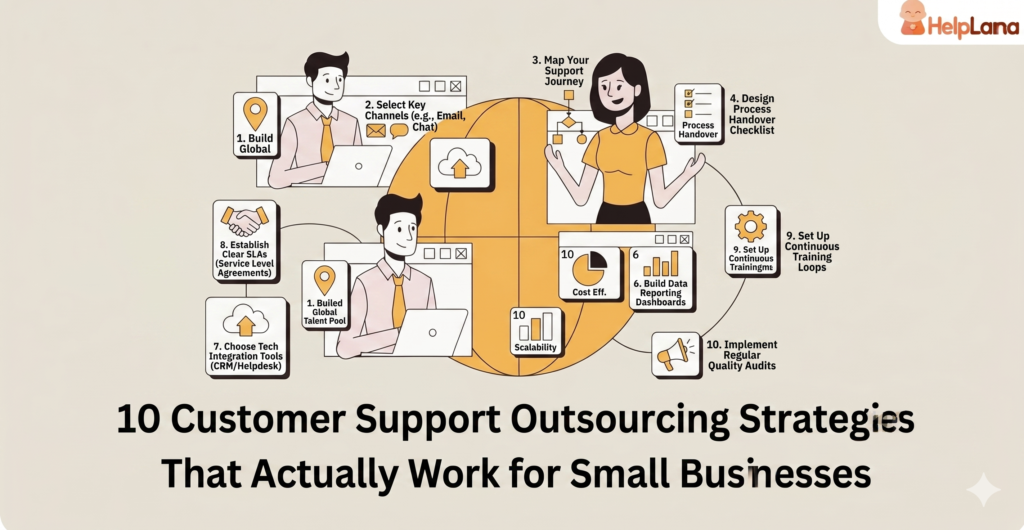
But there’s a big difference between outsourcing strategically and just handing your phone lines to whoever is cheapest. This guide breaks down the 10 most effective customer support outsourcing strategies for small businesses, backed by real data, so you can scale your support without sacrificing quality.
Why Small Businesses Are Outsourcing Customer Support
The numbers tell a clear story:
📊 The global contact center outsourcing market is worth $125.73 billion in 2026 and is projected to reach $189.49 billion by 2031 — growing at 8.55% CAGR (Statista, 2026).
But the reason small businesses outsource isn’t just market momentum. According to Deloitte’s Global Outsourcing Survey 2025, over 70% of organizations cite customer experience (CX) improvement — not just cost savings — as a primary driver. Here’s why that matters for small businesses specifically:
- Cost: Outsourcing customer service can reduce labor costs by 40–70% compared to in-house staffing (IAOP, 2023 Global Outsourcing Report).
- Speed to scale: External providers can deploy trained agents in weeks, not months.
- 24/7 coverage: 80% of customers would leave a brand after a single bad service experience (mindStart, 2025). Round-the-clock support prevents that.
- Channel expertise: 41% of customers prefer live chat; 32% prefer phone (HubSpot, 2024). A specialist provider covers all channels out of the box.
- Focus: 27% of small businesses outsource customer service specifically to free up internal teams to focus on growth (Clutch, 2023).
Before You Outsource: 6 Key Principles for Small Businesses
These principles apply regardless of which strategy you choose. Skipping them is the number one reason outsourcing fails.
1. Define Your Support Scope Precisely
Don’t say “customer support.” Say: “handling 60–80 inbound email and live chat tickets per day, first-response target under 2 hours, covering returns, order tracking, and product FAQs.” The more specific your scope, the better your vendor can staff, train, and price for it.
2. Decide Which Channels to Outsource
Phone, email, live chat, and social DMs all have different staffing, skill, and cost profiles. Start with your highest-volume channel first, get that working well, then expand. Don’t try to outsource everything at once.
3. Set KPIs Before Day One
CSAT, first response time, first contact resolution rate, average handle time — define these before you sign anything. KPIs give both parties clear accountability and make it easy to spot problems early.
4. Run a Paid Pilot First
A 30–60 day pilot on a limited scope lets you test quality, communication, and fit before committing to a long contract. Never skip the pilot — no matter how impressive the vendor’s sales pitch.
5. Protect Your Customer Data
Any external team handling customer queries will touch names, emails, order history, and potentially payment data. Ensure the vendor meets your data privacy obligations (GDPR, CCPA, etc.) and always sign NDAs and data processing agreements.
6. Build a Brand Voice Guide
Your outsourced agents are the voice of your brand. Give them a tone guide, FAQ document, escalation playbook, and sample responses before they take their first ticket. The more context you give, the less coaching you’ll need later.
10 Customer Support Outsourcing Strategies for Small Businesses
📊 Customer service remains the most outsourced function globally, with 38% of businesses outsourcing it. Companies report average cost savings of 15–30% — with offshore models reaching 40–70% (PwC 2024 / IAOP 2023).
1. Start With Your Highest-Volume Channel
Best For: Businesses New to Outsourcing

The smartest entry point into customer support outsourcing is your busiest channel — the one that’s creating the most backlog or burning out your internal team. For most small businesses, that’s email or live chat.
Starting with a single, high-volume channel gives you a clean test environment. You can measure quality clearly, iterate quickly, and build trust with the vendor before expanding to more complex or sensitive touchpoints like phone support.
Once your outsourced team is handling that channel consistently — CSAT stable, response times on target — add the next channel. Gradual expansion reduces risk and improves quality at every stage.
2. Use a Dedicated Agent Model
Best For: Businesses That Need Brand Consistency

3. Outsource Tier-1 Support, Keep Tier-2 In-House
Best For: Technical or Complex Products
Not all support issues are equal. Tier-1 issues — order tracking, returns, FAQs, password resets, shipping queries — are high-volume, well-documented, and easy to script. They’re ideal for outsourcing.
Tier-2 issues — billing disputes, technical bugs, complex complaints, escalations — require deeper product knowledge or internal system access. These are best kept in-house, at least initially.
This tiered approach lets you outsource the bulk of your ticket volume (often 70–80% of all contacts) while keeping your most sensitive interactions under internal control. Over time, as your outsourced team builds expertise, you can gradually hand off more complex tiers.
4. Implement a Hybrid Human + AI Support Model
Best For: High-Volume, Cost-Conscious Teams

5. Go Omnichannel From Day One
Best For: Businesses With Customers on Multiple Platforms
6. Use Nearshoring for Time-Zone Alignment
Best For: US Businesses Needing Real-Time Collaboration
7. Outsource for Peak Season Coverage
Best For: E-Commerce, Retail, and Seasonal Businesses
8. Build a Proactive Support Layer
Best For: Subscription and Retention-Focused Businesses
9. Measure and Optimise With Monthly Reviews
Best For: All Businesses — Non-Negotiable
10. Use Performance-Based Contracts
Best For: Accountability-Focused Partnerships
The final — and most overlooked — strategy is structuring your outsourcing contract around results, not just time and resources. Performance-based contracts tie a portion of the vendor’s compensation (or contract renewal) to measurable outcomes: CSAT scores, resolution rates, response times.
This aligns your vendor’s incentives with your customers’ experience. Instead of being paid simply for showing up, they’re rewarded for delivering results — which drives higher effort, lower error rates, and a more engaged team.
Most reputable providers — including Helplama, which backs its service with a zero-risk money-back guarantee — are willing to put quality commitments in writing. Always ask what the vendor is prepared to guarantee. If they hesitate, that tells you something important.
See Helplama’s zero-risk guarantee →
Must Read: How to Choose a Customer Support Outsourcing Partner: What Small Businesses Need to Know
What Does Outsourcing Customer Support Cost? (2026 Real-World Pricing)
Pricing varies by model, channel, geography, and volume. Here are the real benchmarks from 2026 industry sources:

Key Cost Factors
- Geography: Offshore agents cost $6–$14/hour; US-based agents run $29–$42/hour in 2026 (crescendo.ai). The gap is real — but so is the quality difference in language and cultural alignment.
- Model: Shared agents cost less but deliver inconsistent quality. Dedicated agents cost more but build product knowledge over time — usually worth it for SMBs.
- Volume: Higher ticket or call volumes unlock better per-unit rates. Always ask for volume-based pricing tiers.
- Channels: Voice support costs more than email or chat due to real-time staffing requirements. Omnichannel adds complexity — and cost — but also consolidates vendors.
- Contract length: Month-to-month flexibility comes at a premium. Lock in a longer term only after a successful trial period.
For most small businesses, a realistic starting budget for outsourced customer support runs $1,000–$3,500/month — a fraction of the cost of a full-time in-house agent when you factor in salary, benefits, training, and coverage gaps. (A full-time US support agent costs $35,000–$45,000/year in salary alone, excluding overhead — CustomerThink, 2025.)
Conclusion
Customer support outsourcing isn’t a shortcut — it’s a strategic decision that, when executed well, lets small businesses deliver enterprise-level support without enterprise-level headcount costs.
The data is clear: customer service is the most outsourced function globally, and the businesses doing it strategically — with defined KPIs, the right model, and the right partner — are seeing real gains in CSAT, cost efficiency, and customer retention.
Start with your highest-volume channel, run a pilot, measure everything, and build from there. Helplama gives small businesses a fast, low-risk starting point: US-based trained agents, flexible pricing, and a zero-risk money-back guarantee — so you can outsource customer support with confidence from day one.